
General liability and workers’ compensation are two separate policies that protect against two completely different risks. General liability covers situations where someone outside your business gets hurt or their property is damaged. Workers’ comp covers situations where someone inside your business, specifically an employee, gets hurt on the job. Confusing the two, or assuming one replaces the other, is one of the most common coverage gaps California employers carry. Both policies matter, both have distinct legal requirements, and neither substitutes for the other. Here’s exactly what each covers, what each excludes, and what California law requires you to carry.
Key Takeaways
- General liability covers third-party bodily injury, property damage, and advertising injury, but does not cover employee injuries.
- Workers’ comp covers employee injuries and occupational illness but it does not cover third-party claims
- California requires workers’ comp for every employer with one or more employees; general liability is not state-mandated but is functionally unavoidable
- Having general liability without workers’ comp leaves you personally liable for every employee injury that occurs
- Most California businesses with employees need both policies
What Is General Liability Insurance?
General liability insurance is a policy that protects a business from financial loss when a third party ( a customer, vendor, visitor, or member of the public) suffers bodily injury or property damage because of the business’s operations, products, or premises.
What General Liability Covers
General liability covers five categories of loss:
- Bodily injury to third parties: A customer slips and falls at your location, or a contractor’s work causes injury to a bystander
- Property damage to third parties: Your employee accidentally damages a client’s property while on-site
- Personal and advertising injury: Claims of libel, slander, copyright infringement, or false advertising
- Products and completed operations: Injury or damage caused by a product you sold or work you completed after the job is done
- Legal defense costs: Attorney fees, court costs, and settlements, even for claims that are ultimately dismissed
What General Liability Covers
General liability has five clear exclusions that employers frequently misunderstand:
- Injuries to your own employees: Employee injuries are a workers’ comp matter, not GL
- Damage to your own property: Commercial property insurance covers your building and equipment
- Professional errors or bad advice: Professional liability (E&O) covers this exposure
- Auto accidents involving business vehicles: Commercial auto is required for vehicle-related claims
- Intentional acts or criminal conduct: No liability policy covers deliberate harm
What Is Workers' Compensation Insurance?
Workers’ compensation insurance is a policy that covers employees who suffer work-related injuries or occupational illnesses. It operates on a no-fault basis: the employee does not need to prove the employer was negligent to receive benefits, and the employer is shielded from most personal injury lawsuits by covered employees in exchange for providing coverage.
What Workers’ Compensation Covers
Workers’ comp provides five categories of benefits to injured California employees:
- Medical treatment: All reasonable and necessary care related to the work injury, delivered through the employer’s Medical Provider Network (MPN)
- Temporary Disability (TD) benefits: Wage replacement at two-thirds of average weekly wages while the employee recovers
- Permanent Disability (PD) benefits: Compensation for lasting functional impairment, rated from 1% to 100%
- Supplemental Job Displacement Benefits (SJDB): A vocational retraining voucher worth up to $6,000 if the employee cannot return to their prior role
- Death benefits: Payments to qualifying dependents when a workplace injury or illness is fatal
What Workers’ Compensation Does NOT Cover
Four categories fall outside workers’ comp coverage:
- Injuries to independent contractors: Workers’ comp only covers employees; contractor injuries are their own responsibility, subject to California AB5 classification rules
- Injuries outside the course and scope of employment: An employee injured on a personal errand during work hours may not qualify
- Injuries caused by employee intoxication or intentional self-harm: These are excluded under California law
- Third-party claims: If a customer is injured at your business, that is a general liability matter, not workers’ comp
General Liability vs. Workers' Comp: A Side-by-Side Comparison
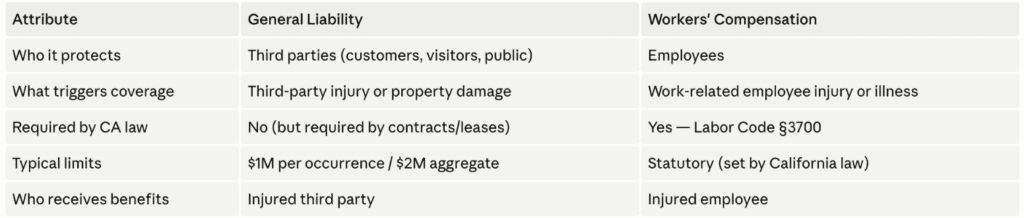
Does General Liability Cover Workers' Comp Claims?
No. General liability and workers’ comp cover entirely different parties. General liability responds when a third party makes a claim against your business. Workers’ comp responds when an employee is hurt. The two policies do not overlap.
The practical consequence: a California employer who carries general liability coverage but no workers’ comp is personally liable for the full cost of any employee injury: medical bills, disability payments, and legal fees. According to the California Division of Workers’ Compensation, the average indemnity claim cost exceeds $50,000, and claims involving surgery or long-term disability routinely reach $150,000–$250,000. California also imposes a minimum $10,000 civil penalty per uninsured employee under Labor Code §3722, plus potential criminal misdemeanor charges.
What California Law Requires — GL vs. Workers' Comp
Workers’ comp is mandatory. California Labor Code §3700 requires every employer with one or more employees to carry workers’ compensation insurance. There are no industry exceptions and no size thresholds. The first hire triggers the requirement.
General liability is not state-mandated for most California businesses, but it’s effectively required by the market. Commercial landlords require it as a lease condition. Most client service contracts specify minimum GL limits, often $1M or $2M per occurrence. Contractor licensing boards require it. Operating without it means absorbing third-party claims out of pocket
When You Need Both — and When One Policy Might Be Enough
Most California businesses with employees need both. A contractor, retailer, restaurateur, or service provider with even one employee faces both third-party liability exposure and employee injury exposure simultaneously. One policy does not substitute for the other.
Sole proprietors with no employees need general liability but are not required by California law to carry workers’ comp. They can elect to cover themselves voluntarily, which is often worth doing in high-risk trades.
Independent contractors under California AB5 present a specific complication. AB5 reclassifies many workers previously treated as independent contractors as employees, which triggers a workers’ comp obligation. If you’re using contractors who might qualify as employees under the ABC test, that determination should happen before a claim does. Learn more about California workers’ comp requirements and employer obligations.
Commercial auto and professional liability are separate policies that cover separate risks. Neither replaces GL or workers’ comp. A business with vehicles, professional services, and employees typically needs four policies: GL, workers’ comp, commercial auto, and professional liability.
Cost Overview — General Liability vs. Workers' Comp in California
General liability cost in California is driven by five factors: industry classification (construction costs more than consulting), annual revenue, number of employees, prior claims history, and location. Urban Southern California rates run higher than suburban or rural areas due to claim frequency and legal costs. According to industry data from the Insurance Information Institute, most California small businesses pay $500 to $3,000 per year for a standard $1M/$2M GL policy, though rates vary significantly by industry and claims history.
Workers’ compensation cost is more variable. Rates are calculated per $100 of payroll, by class code. A clerical office employee might cost $0.30 per $100 of payroll annually. A roofer can exceed $20 per $100. The experience modification factor (or better known as x-mod, a multiplier based on your claims history relative to industry peers) adjusts your base rate up or down. A 1.30 e-mod adds 30% to your premium; a 0.80 e-mod saves 20%.
Make Sure Your Business Has Both — and the Right Limits
General liability and workers’ comp serve different purposes and cover different risks. A California employer who treats one as a substitute for the other is exposed on the uncovered side. Getting both policies structured correctly, with limits that match your contracts, payroll, and industry, is where coverage decisions get consequential.
At Arroyo Insurance Services South Bay, we work with California employers across construction, healthcare, transportation, and professional services to structure GL and workers’ comp programs that meet legal requirements and hold up when claims happen. Request a quote online today!.
Frequently Asked Questions
Does general liability insurance cover workers’ compensation?
No. General liability covers third-party claims like injuries or property damage to people outside your business. Workers’ comp covers employee injuries. The two policies cover entirely different parties and risks. A general liability policy will not pay workers’ comp benefits to an injured employee.
What is the difference between workers’ comp and employers’ liability?
Workers’ comp pays statutory benefits to injured employees. Employers’ liability is a separate coverage (usually Part B of a workers’ comp policy) that protects the employer if an employee sues for damages beyond the workers’ comp system, such as a claim of gross negligence. Employers’ liability limits are typically $100,000 to $1,000,000 per occurrence.
Is general liability insurance required for California employers?
Not by state law, for most businesses. California does not have a universal general liability mandate. However, it is required by most commercial leases, client contracts, and licensing boards. Contractors licensed by the CSLB, for example, must carry general liability as a condition of licensure.
Do I need workers’ comp if I only use independent contractors?
It depends on classification. If the workers genuinely qualify as independent contractors under California’s AB5 ABC test, workers’ comp is not required for them. If they would be reclassified as employees under AB5, workers’ comp coverage is required. Misclassification is a significant legal exposure in California.
Can a sole proprietor in California have just general liability and no workers’ comp?
Yes, if the sole proprietor has no employees. California’s workers’ comp mandate applies to employers with employees. A sole proprietor with no employees is not required to carry workers’ comp, though they can elect to cover themselves. General liability is still advisable for any sole proprietor with client-facing work.
Do I need both general liability and workers’ comp for a small business with one employee?
Yes. The moment a California business has one employee, workers’ comp is legally required. General liability is not legally required by the state, but most commercial leases and client contracts will require it regardless of business size. A business with one employee and a leased space almost certainly needs both.