Most California employers buying group health insurance focus on the plan itself, deductibles, networks and premiums. What they don’t realize is that the rate structure used to price their coverage depends entirely on their group size, and that structure can swing their total benefits cost by thousands of dollars per year. Small group employers (1–100 employees) are priced using age-banded rates. Large group employers (101 and above) typically use composite rates. The difference between those two methods is not academic; it directly determines what your oldest and youngest employees cost to cover, how predictable your renewal will be, and which carriers and plan designs you can access.
Key Takeaways
- California defines small group as 1–100 employees and large group as 101 or more
- Small group plans use age-banded rates: each employee is priced individually by age
- Large group plans typically use composite rates: one blended rate per coverage tier, regardless of individual employee ages
- An older workforce pays significantly more under age-banded pricing than under composite pricing
- Employers approaching 100 employees should model both rate structures before crossing the threshold
How California Defines Small Group vs. Large Group Employers
California defines small group as any employer with 1 to 100 employees; a large group begins at 101 employees. That threshold determines which market your business buys in, which carriers will quote you, which ACA rules apply, and how your premiums are calculated.
Small group plans in California are subject to ACA community rating rules, guaranteed issue requirements, and essential health benefit mandates. Large group plans operate under different rules: carriers can experience-rate your group, essential health benefit requirements do not apply, and self-funded plan designs become available. The 100-employee line is not just administrative, it’s a structural divide in how health insurance is priced and regulated.
What Are Age-Banded Rates?
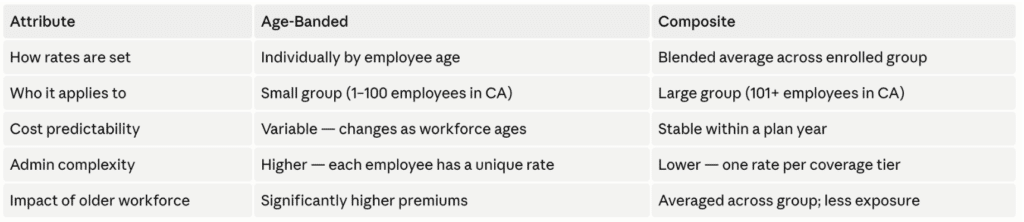
Age-banded rates are a pricing method where each employee’s premium is set individually based on their age. The carrier assigns a rate to every age from 21 to 64, and each employee pays the rate that corresponds to their age at enrollment.
The ACA caps the age ratio at 3:1, meaning the oldest enrollee cannot be charged more than three times what the youngest enrollee pays for the same plan. In practice, a 25-year-old employee might cost $350 per month in employee-only coverage. A 60-year-old on the same plan costs $1,050 per month. That is a $700 monthly difference for the same coverage. Multiply that across a workforce where half the employees are over 50, and the total premium exposure climbs fast.
What Are Composite Rates?
Composite rates are a pricing method where the carrier calculates one blended average premium per coverage tier, applied equally to all enrolled employees in that tier regardless of individual age.
The four standard tiers are: employee only, employee plus spouse, employee plus child, and family. The carrier models the age distribution of the entire enrolled group, averages the expected cost, and produces a single rate for each tier. A 30-year-old and a 58-year-old enrolling in employee-only coverage pay the same monthly premium.
Composite rates apply to California large group plans (101+ employees). They simplify payroll administration significantly and reduce premium volatility driven by workforce age. The tradeoff: employers with very young workforces may pay more under composite pricing than they would under age-banded rates.
Age-Banded vs. Composite Rates — Side-by-Side Comparison
How Rate Structure Affects Your Benefits Budget
When Age-Banded Rates Work Against You
Age-banded pricing hurts employers with older workforces. A 20-person professional services firm in Long Beach where the average employee age is 52 will pay premiums close to the top of the age band. If 15 of those 20 employees are between 50 and 62, the employer is effectively paying near-maximum rates for the majority of the group. Under composite pricing for the same group, the cost would be averaged down.
When Composite Rates Can Cost More
Composite rates do not always save money. A tech startup with 110 employees where 90% are under 35 would pay below-average age-banded rates if they qualified for small group pricing. Under composite rates, that young workforce gets averaged with whatever older employees exist in the group, potentially raising the per-employee cost above what age-banded pricing would produce.
The 100-Employee Threshold — A Planning Opportunity
Employers at 95 to 105 employees are at a decision point. Crossing from small group to large group changes the rate structure, the carrier market, and the plan design options available. A broker should model both scenario before the employer crosses 100 employees. The direction of the cost difference depends entirely on workforce age distribution.
Other Key Differences Between Small and Large Group Plans in California
Four differences beyond the rate structure matter to California employers:
- ACA essential health benefits: Small group plans must cover all 10 ACA essential health benefit categories, including maternity, mental health, and substance use treatment. Large group plans are not subject to this mandate.
- Rate review: Small group premiums are community-rated, meaning they are tied to regional trend data. Large group premiums are experience-rated, which means your group’s actual claims history drives your renewal cost.
- Carrier options: Small group has a defined set of carriers in each California region. Large group opens access to additional carriers and self-funded plan structures.
- Renewal pricing: Small group renews on statewide trend increases. Large group renews based on your own claims experience, which can produce lower increases for healthy groups or higher ones for groups with significant claims.
Self-Funded and Level-Funded Plans — The Large Group Advantage
Two plan structures become available at large group sizes that are not practical for most small employers:
Self-funded plans mean the employer pays employee claims directly rather than paying a fixed premium to a carrier. The employer buys stop-loss insurance to cap exposure on catastrophic individual claims (specific stop-loss) and total annual claims (aggregate stop-loss). Self-funded plans give employers full visibility into claims data and eliminate carrier profit margin from the premium equation.
Level-funded plans operate like fully insured plans from a cash flow standpoint — the employer pays a fixed monthly amount — but include a claims reconciliation at year end. If actual claims come in below the funded amount, the employer receives a partial refund. Level-funded plans are available to some groups as small as 25 employees in California, making them an option worth exploring for healthy small groups as well.
Both structures reward employers with healthy, lower-utilization workforces and give HR teams more data to act on than a traditional fully insured plan provides.
How to Choose the Right Plan Structure for Your California Business
The right structure depends on group size, workforce age, claims history, and risk tolerance.
Small group employers should focus on modeling age-banded premiums across different plan options, using a Section 125 Cafeteria Plan to let employees pay their share pre-tax, and selecting carriers that offer the network quality their workforce expects. Arroyo’s group medical, dental, and vision programs are structured specifically for Southern California small group employers, but we also have many programs for out of state small group employers.
Large group employers should model composite vs. age-banded options if carriers offer both, evaluate self-funded and level-funded designs, and review their claims experience before each renewal. A clean three-year loss run is leverage in the large group market.
Both groups benefit from working with an independent broker who quotes the full market rather than placing business with a single carrier.
Build a Health Insurance Strategy That Fits Your Group Size
Group size determines your rate structure, your carrier options, and your regulatory obligations. Most California employers do not get a side-by-side comparison of how those variables interact — they get a renewal quote and a deadline.
At Arroyo Insurance Services South Bay, we work with Southern California employers across every group size to model rate structures, compare carriers, and build employee benefits programs that control costs and hold up at renewal. Request a quote online today or speak with one of our experts!
Frequently Asked Questions
What is the difference between small-group and large-group health insurance in California?
Small group health insurance in California covers employers with 1 to 100 employees, uses age-banded rates, and is subject to ACA community rating and essential health benefit rules. Large group health insurance covers employers with 101 or more employees, typically uses composite rates, is experience-rated at renewal, and is not subject to ACA essential health benefit mandates.
What are age-banded rates for health insurance?
Age-banded rates are a pricing method where each employee’s health insurance premium is set based on their individual age. The ACA caps the ratio at 3:1, meaning the oldest enrollee can be charged no more than three times the premium of the youngest. Age-banded rates apply to all California small group plans.
What are composite rates for employer health insurance?
Composite rates are a pricing method where the carrier calculates one blended average premium per coverage tier (employee only, employee plus spouse, employee plus child, or family) applied equally to all employees in that tier regardless of age. Composite rates are standard in California large group plans.
Are age-banded rates or composite rates better for my business?
It depends on your workforce age distribution. Age-banded rates favor employers with younger workforces. Composite rates favor employers with older or mixed-age workforces. Employers near the 100-employee threshold should model both before committing to a plan structure.
At what size does a California employer move from a small group to a large group?
A California employer moves from small group to large group at 101 employees. Small group is defined as 1 to 100 employees under California law, which aligns with the ACA’s definition for states that adopted the 100-employee threshold.
Can a small group employer use composite rates in California?
Generally no. California small group plans are required to use age-banded rates under ACA community rating rules. Some carriers may offer composite-style billing for administrative simplicity, but the underlying rate calculation remains age-banded. Composite rates as a true pricing method are a large group feature.